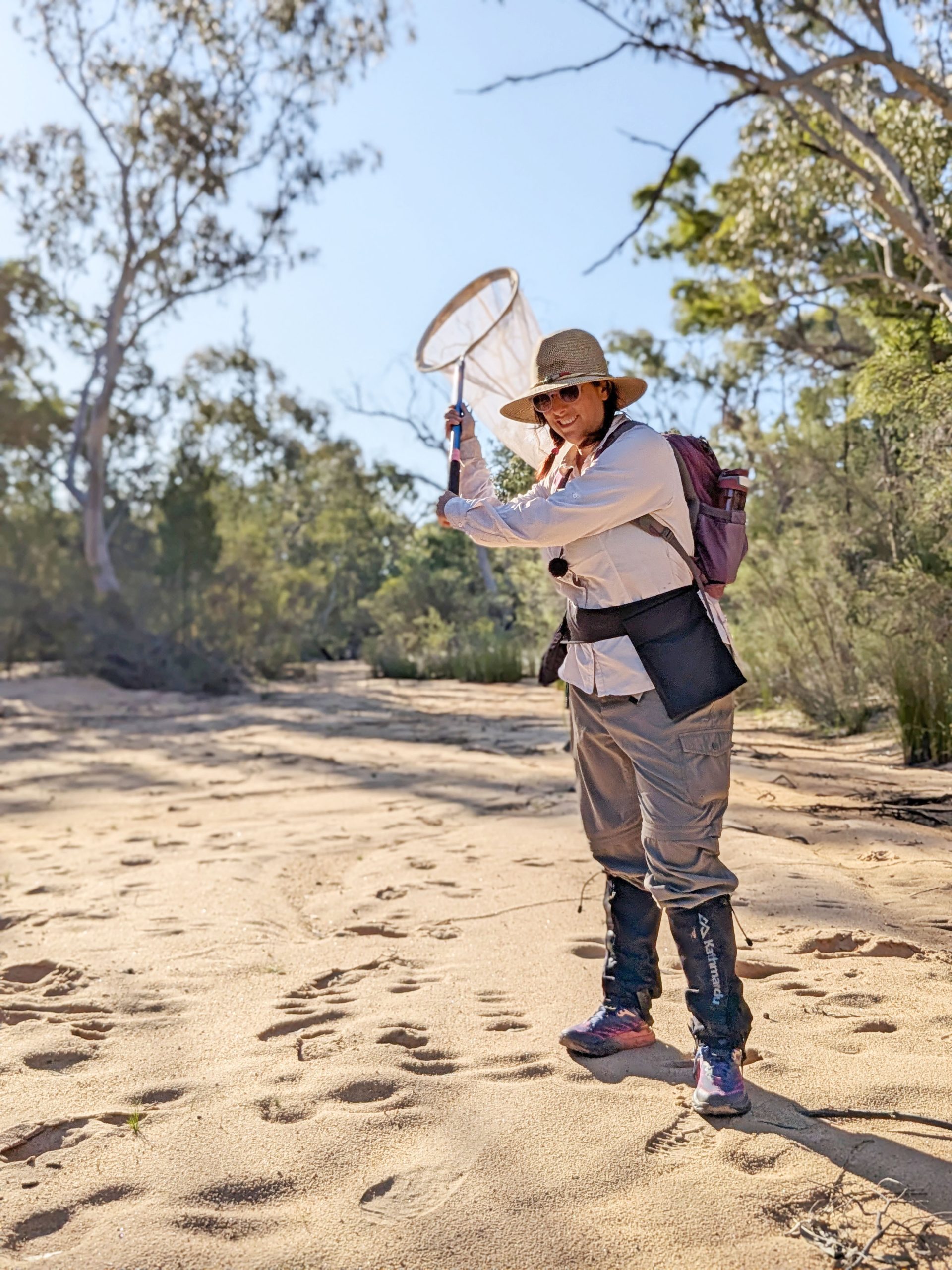
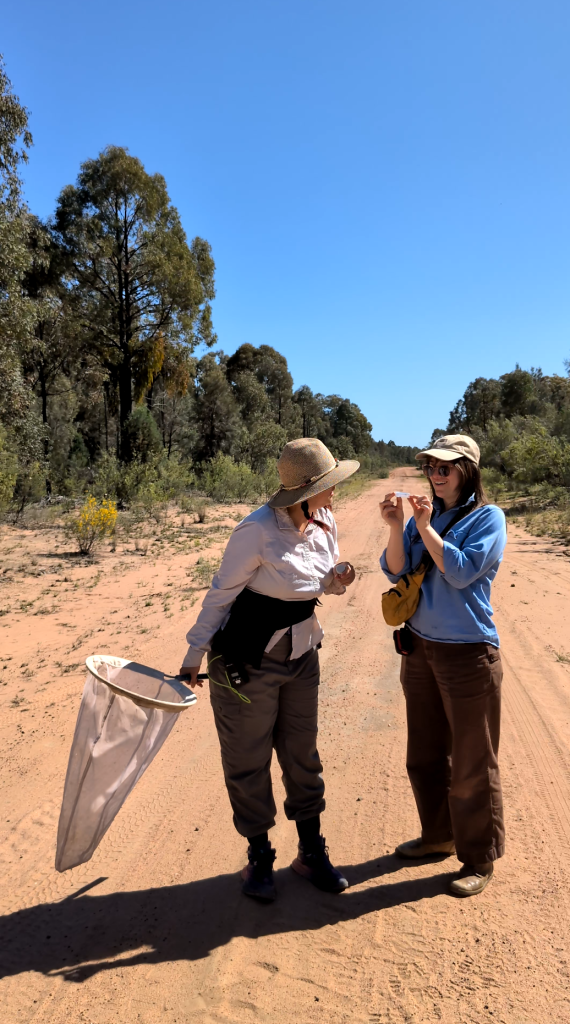
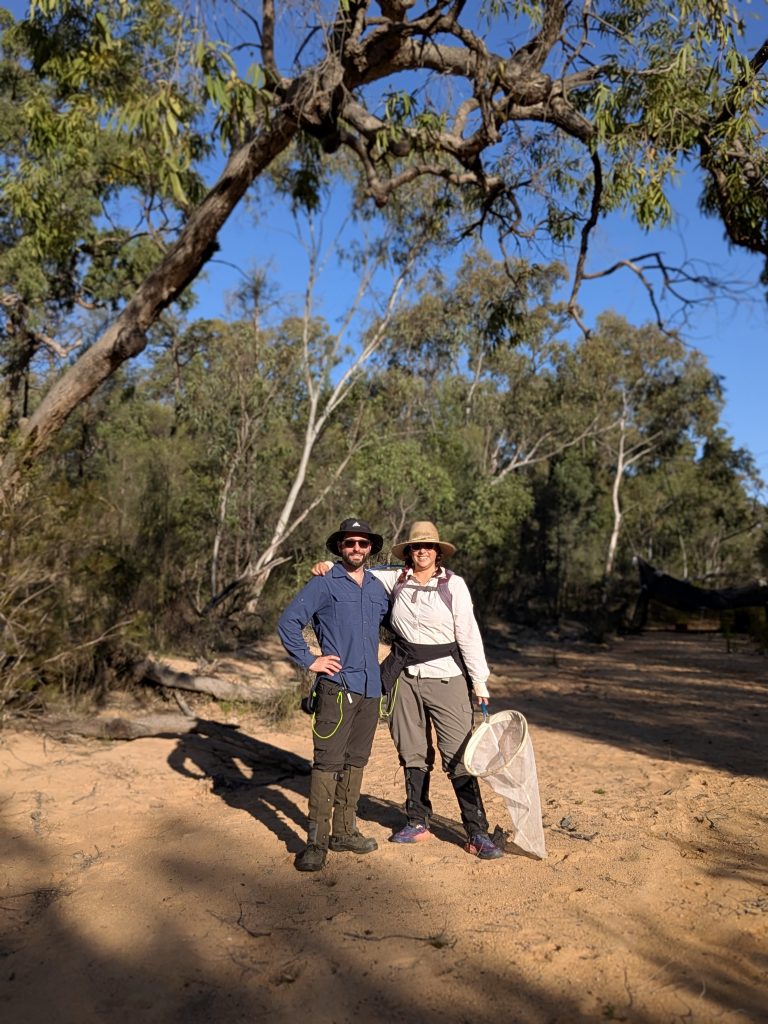
Dr Juanita Rodriguez (CSIRO Research Entomologist) searching for spider wasps on the Pilliga Bush Blitz (image: Bryan Lessard, Bush Blitz).
Are wasps really that scary? Can they help us in the garden? What if they could take the sting out of our next headache using their venom?
Meet Dr Juanita Rodriguez, an entomologist at CSIRO’s Australian National Insect Collection who’s dedicated her career to all things wasps, from naming species new to science to unlocking potential new medicines from their venom.
Take a walk on the wild side with Bry the Fly Guy as he interviews Juanita on a Bush Blitz to the Pilliga (NSW) as they search high and low for wasps. You won’t believe what they uncover!
Bush Blitz Q&A with Dr Juanita Rodriguez, CSIRO Entomologist
Bry: Juanita, what are you looking for on the Pilliga Bush Blitz?
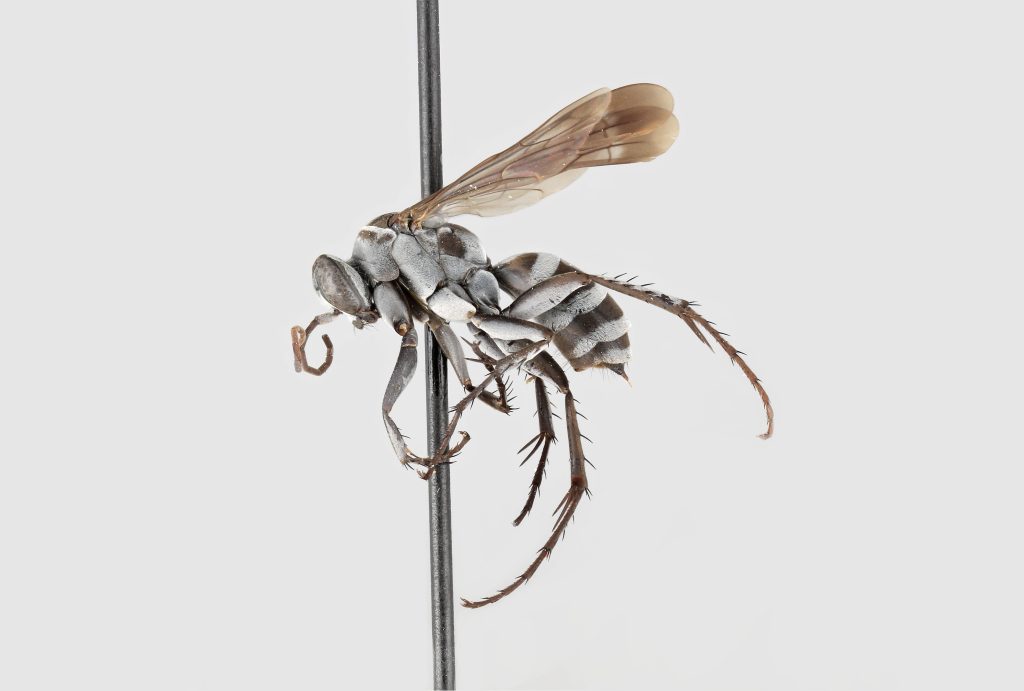
Juanita: I’m looking for spider wasps (family Pompilidae). They are not flying spiders! They are wasps that look for spiders, sting them, paralyse them, and then lay an egg on them so that their baby larvae will feed on the paralysed spider that’s still alive. When the baby hatches, it eats the spider. They’re very sneaky.
So without wasps, we’d have way more spiders crawling around?
Exactly. If you don’t like spiders, spider wasps are your friends. They’re not evil but are really helping to control spider populations and are good at pollinating.
Can wasps paralyse humans?
They cannot paralyse humans because the amount of venom that they inject is too small. But their sting does cause a lot of pain thanks to the toxins in the venom. We’re looking into wasp venom because they can be modulators of sodium channels in the central nervous system. We’re trying to figure out what effect wasp venom could have on humans and see if we could turn venom into potential new drugs.
Does that mean that wasps might take the sting out of our next headache?
Even better than that, they might be used to treat conditions like epilepsy and Alzheimer’s. Wasp venom can also be used to understand how pain is produced and how we can treat it. My research is also looking at how different species have different venom compounds. One day we might be able to treat conditions like Alzheimer’s with the sting of a wasp.
How did you fall in love with wasps?
When I was at university, I started looking at insects under the microscope and thought they were fascinating. They looked like little aliens and I became very interested in the diversity and all that is unknown about them. Then I got the opportunity to start working on wasps through a scholarship where I met spider wasps, and I fell absolutely in love with them!
What’s your favourite wasp species?
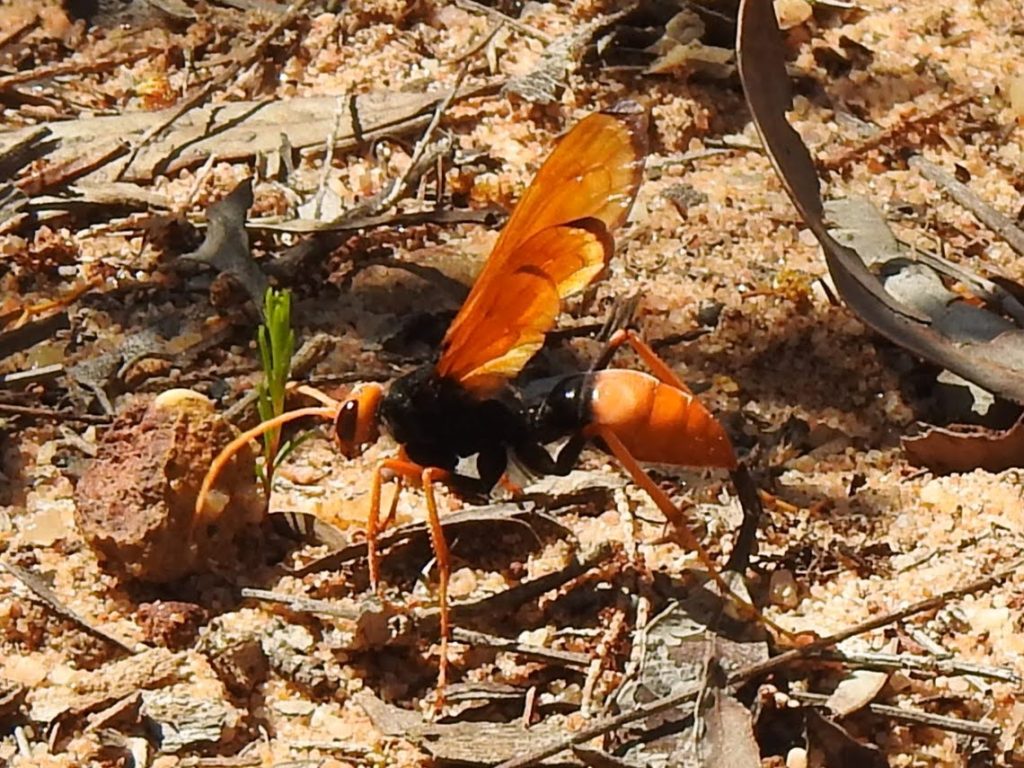
Oh, that’s a difficult question because I love wasps so much. There’s such a diversity – Australia has more than 12,000 species – so it’s very difficult to pick a favourite. But I guess right now, my favourite are spider wasps. Orange and black spider wasps (from the genus Heterodontonyx) are very cool because they are so large and strong that females can carry a huntsman spider to its nest.
Don’t skip leg day for the spider wasp, right?
Exactly. They have really strong legs and mandibles they use to carry spiders that are 10 or 20 times their size. They are very difficult to catch because they’re very sneaky. Sometimes when you put your insect net over them, they will crawl out of the net and fly away.
What happens if someone wished that one day all the wasps would just disappear on earth?
Wasps are very good at controlling the populations of other bugs, like spiders, so they’re really good pest managers. We can actually use wasps as biocontrol agents to control pest species in agricultural landscapes or in the general environment.
Could wasps help out in our gardens?
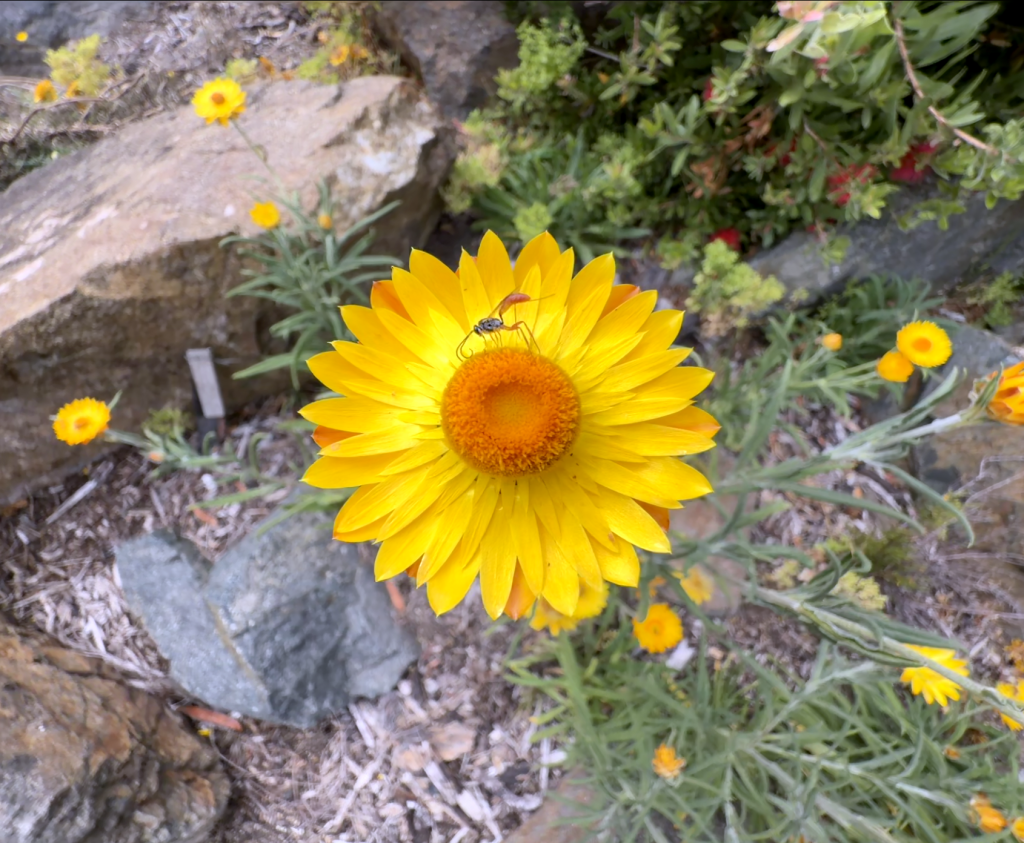
Yes, we want them in our gardens because they can help make sure that we don’t have too many other bugs or pests that are attacking our plants. Wasps also help pollinate. The honeybee (Apis mellifera) is good at pollinating because they’re very fluffy, and they have these pollen baskets that carry a lot of pollen. But it has been found that many native bees, wasps, and even flies are actually really good at pollinating too. Adult wasps feed on pollen and nectar and buzz from flower to flower to help pollinate native plants.
What should someone do if they see a wasp in their backyard?
It’s best to leave them alone and not disturb them. Usually, wasps are not aggressive or looking to hurt you, unless you disturb a nest. For example, it’s good not to go close to large nests like those made by the European wasp (Vespula germanica). If there is a wasp flying around, just let it fly around and it’ll leave on its own.
What’s the most recent specimen you’ve collected?
It’s a vespid from the same family as paper wasps (family Vespidae). They are very difficult to catch and this particular group builds nests in mud or on the ground.
How do you collect wasps for research?
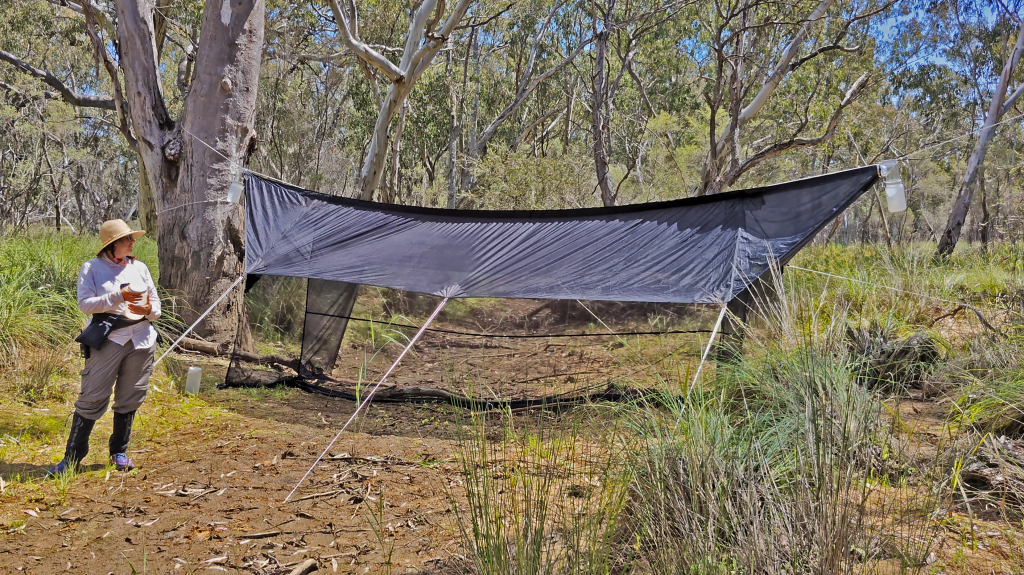
I like to use a malaise or flight intercept trap that looks like a little mesh tent for bugs that we put across a creek or a dry wash. These traps are very good at catching flying insects, like flies and wasps. They fly into it because it’s dark, so they don’t see it, and then crawl to the top, which is white, so they think it’s the way out. Then they fall into a collecting jar full of ethanol that helps preserve the specimens. Then we can study them later by extracting their DNA and sequencing their genomes to understand them better.
What are you hoping to find in this trap?
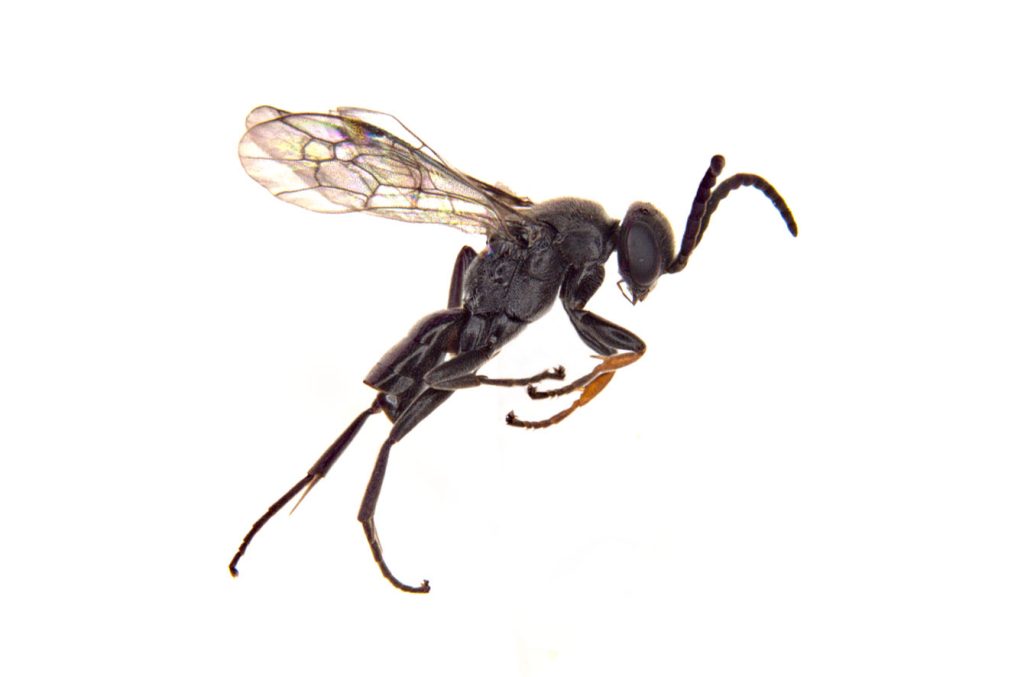
I’m looking for spider wasps. These traps catch more spider wasps than I could catch by hand in an entire week. They even catch very rare species and hopefully a very weird group of spider wasps where the females have reduced wings or don’t have wings at all. We don’t yet understand why the wings are reduced in this group of wasps, but it could be because they seem to hang out a lot around ants. They could be mimicking the ants to avoid predators by blending in with them and using the ant group defences to protect them. They’re very sneaky.
Have you named any wasp species?
Yes, I have had the opportunity to name some species like Epipompilus namadgi because it lives in Namadgi National Park (near Canberra). It was found in an area that was badly burned by the Black Summer Bushfires and unfortunately, we haven’t been able to find it since. It could be an endangered species, but we are not sure. The reality is that we have very few specimens of it and it’s very rare, so we are trying to get some baseline data to understand what we have so that we can protect it.
Are there any fossils of wasps?
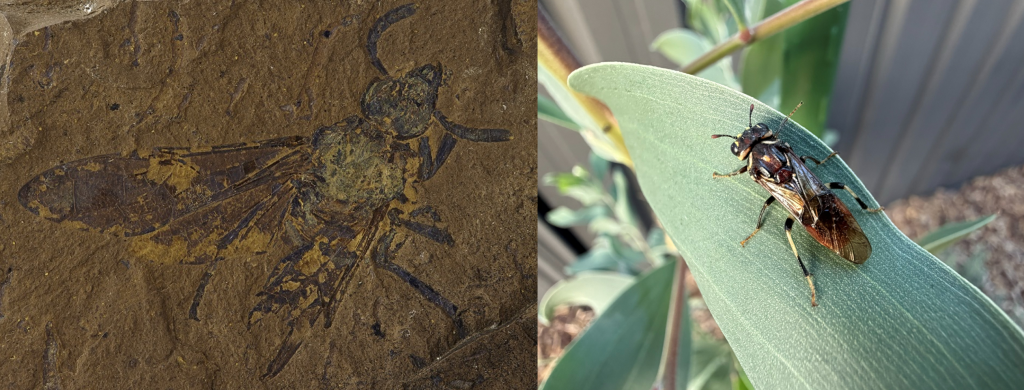
Yes, I love fossils and have described a bunch of ancient wasp species from fossils. We recently described an ancient species of sawfly (family Pergidae) from Australia that used to live around here and lived more than 11 million of years ago.
Is a sawfly a fly or wasp?
Sawflies are closely related to wasps because they are part of the same taxonomic group called Hymenoptera that also includes wasps, bees and ants. It’s called a sawfly because it looks more like a fly as it doesn’t have the classic constricted waist of a wasp. Sawflies use their mouths to chew a hole in a plant that they lay their eggs in that grow into hungry larvae that feed on the plant. Their larvae are also called spitfires and are famous for their chemical defences. It’s Eucalyptus oil that you get from the spitfires because the larvae feed on eucalyptus leaves, separate out the oils and chemicals from leaves, and then ‘spit’ it out as a defence mechanism to avoid predators.
Bees are wasp relatives, so does Australia have many native bees?
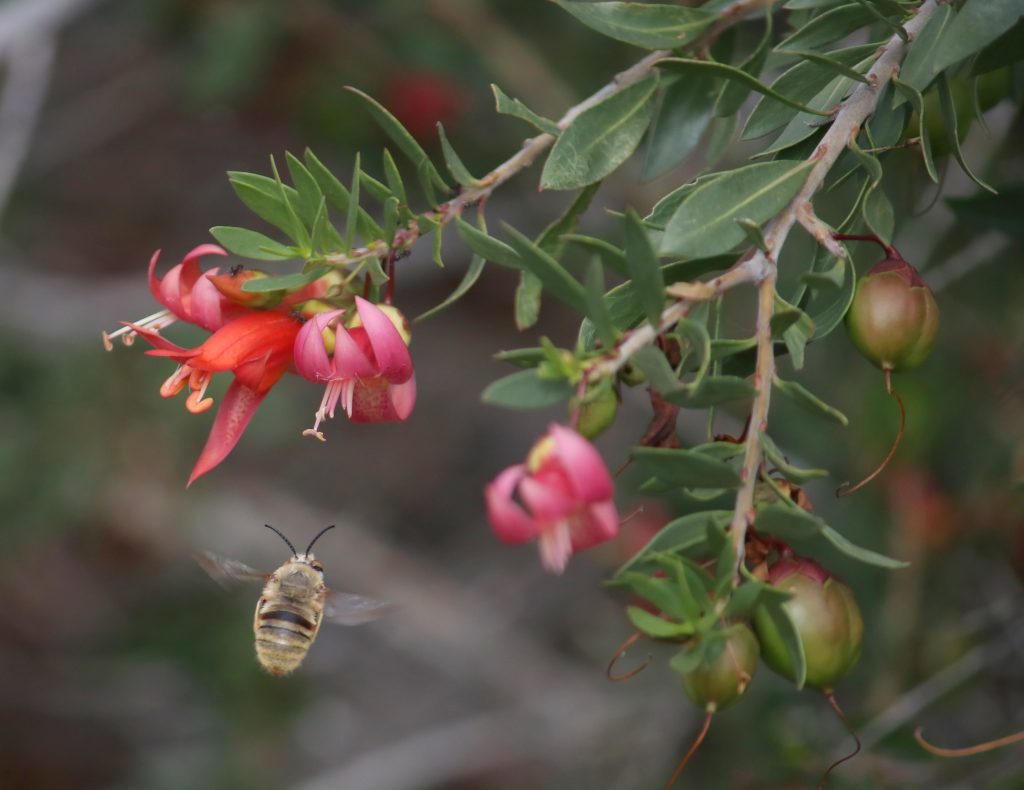
When you think about bees, people usually imagine the European honeybee that are introduced and used very widely in agriculture for pollinating crops. But in reality, there’s over 2,000 native bee species in Australia that are different to the honeybee. There are 1,500 scientifically described species living in Australia, but we estimate that there are around 500 species that still need to be described. We are looking for native bees on this Bush Blitz because we’re trying to describe those 500 undescribed species.
Do all bee species live in hives?
Social bees like the European honeybee live in hives, but most, like 99.5% of native bee species are solitary and they are the ones we are looking for.
Do native bees sting?
Yes, native bees have stingers. But there is one group of native bees that are stingless, social and produce honey – they’re known as a stingless bees or sugar-bag bees. They’re found more in the tropical areas of Australia.
What do you like most about being on a Bush Blitz?
I really like to contribute to the Bush Blitz program, because it’s a way to explore places that have not been very well collected in Australia with potentially a lot of missing diversity that still needs to be scientifically described. We also get to interact with scientists in the field that work with other groups that you have never worked with, and this interaction is very rich because you learn a lot, like different ways of collecting. It’s a great way to network with other scientists.
What’s been the most interesting species you’ve found on this Bush Blitz so far?
I’ve already found over five species of velvet ants (family Mutillidae) that means this area is rich and abundant in species.
What are velvet ants?
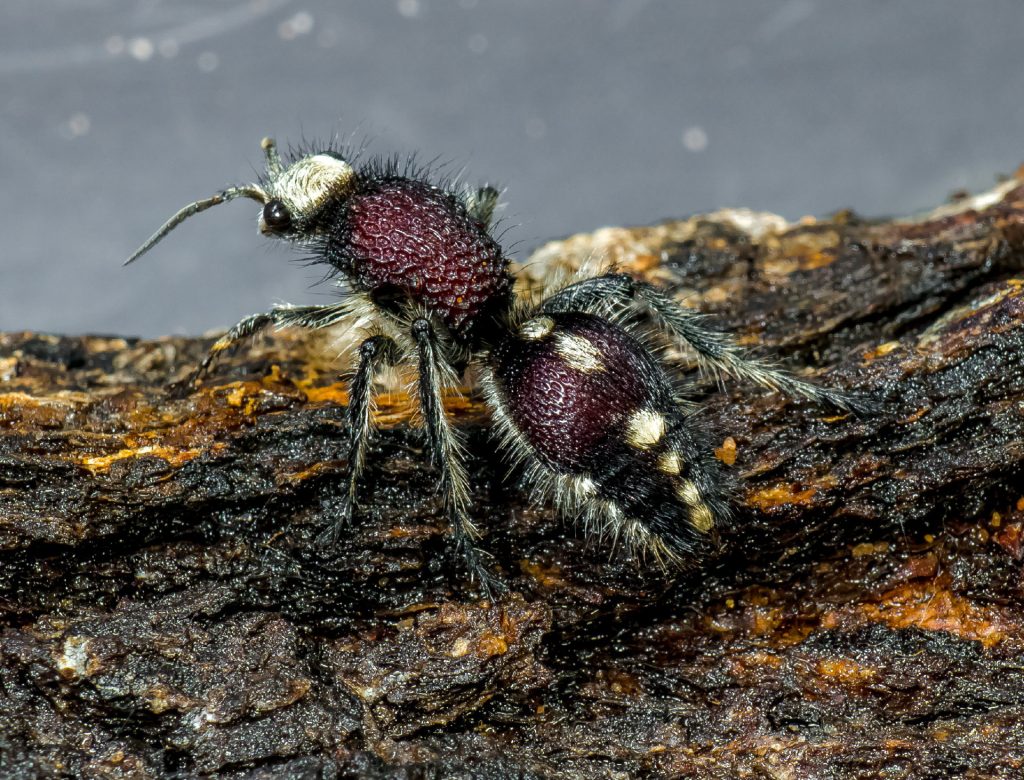
Velvet ants are actually a family of wasps where the females have lost their wings so they look more like ants and are very hairy, so they look velvety. They are very brightly coloured wasps that have a lot of pilosity (hairs) and spots, but even so, they are not very easy to tell apart. They don’t look very different from each other because they are all trying to warn predators off with their bright colours and patterns. We think it’s going to be a good trip to find potential species new to science and enrich the velvet ant tree of life.
How many species of velvet are there in Australia?
We think that there are over 500 so far. There’s only 100 or so species scientifically described, but my PhD student Madalene Giannotta is working on them and slowly describing the missing species that are out there.
What happens to the wasps after you collect them on a Bush Blitz?
We bring the specimens back to the lab and identify them to species, label them properly and curate them back into the collection. We also enter the collection data into a database so the information on where the specimens were found is available to everyone. It’s a lot of work to curate them and keep them safe so that people can study them into the future. People use the specimens to name and describe species new to science, understand how pollinators and populations change through time, understand the biogeography of species and conserve endangered species that need our protection.
How big is your insect collection?
I work at the CSIRO Australian National Insect Collection which is the largest collection of Australian insects in the world. We have close to 12 million specimens in our collection.
Do you have any advice for anyone thinking about becoming a scientist?
My advice is to look at what your skills are. Some of us are good at analysing data, some of us are really good at being out in nature, and some of us like being in the lab. Then according to your skills, you can go into a branch of science that really suits you and that you’ll enjoy.
What’s one last wasp fact that people need to know?
Did you know that female wasps are the only ones that can sting? Males don’t have a stinger and are completely stingless. The stinger is actually a modification of the ovipositor, a straw-like protrusion females use to lay eggs, which means females are the only wasps that have evolved a stinger. Originally it was only used to lay eggs, but overtime it evolved into a stinger so that the females could also inject venom to immobilise other insect hosts and lay their eggs into them so their babies could eat and grow in a safe place. Female wasps are really good at taking care of their babies.
Thank you Juanita! I’ve learned so much about wasps from spending the day with you. I’m going to care more about our little wasp friends from now on.
That makes me really happy. Thanks so much for chatting with me about wasps, which are my favourite thing in the whole world.
Watch Bry and Juanita’s full wasp-packed adventure from the Pilliga Bush Blitz here:
Filmed on Gamilaraay, Gamilaroi and Gomeroi Country
This episode was filmed on the lands of the Gamilaraay, Gamilaroi and Gomeroi peoples in the Pilliga in New South Wales, Australia. We pay our respect to their elders past and present and recognise their deep connection and understanding to the unique biodiversity living on Country.
Bush Blitz to the Pilliga
After two weeks of 4WD’ing across the Pilliga, our Bush Blitz team of 60 scientists, Murrunmala Dhwun rangers and local land managers worked hard to identify the species living on Country. Spoilers! We found a bunch of species new to science! Stay tuned as our scientists’ head back to their labs to identify, DNA sequence and name these new and exciting species.
A huge thank you to the wonderful Coonabarabran Local Aboriginal Land Council and Murrunmala Dhwun Rangers for their assistance and to our friends at the Australian Wildlife Conservancy for hosting our Bush Blitz basecamp.
Get involved!
Have you changed your mind about wasps? Let us know on our Facebook and Instagram pages, or travel Australia with us on our YouTube channel as we meet other researchers looking for species new to science. Who knows, you might even uncover a species new to science living in your own backyard!